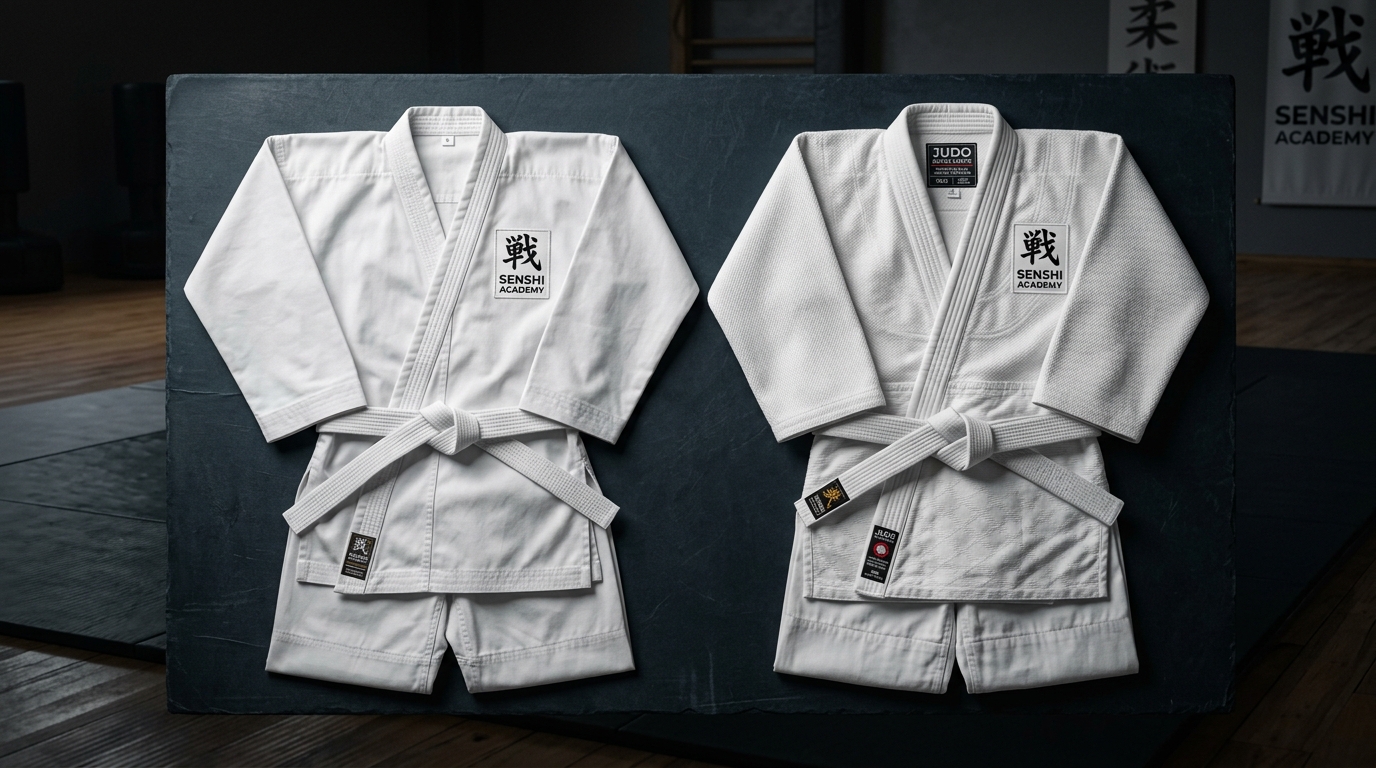
Understanding Martial Arts Uniform Manufacturing
Martial arts uniform programs are deceptively complex. What looks like a simple white suit involves dozens of specification decisions that directly impact performance, durability, regulatory compliance, and brand presentation. Whether you're outfitting a 20-student kids' karate class or supplying a national federation tournament, getting the specifications right before production starts is critical.
In this guide, we break down everything you need to know about ordering custom karate gis, judo suits, and taekwondo doboks — from fabric selection and weave types to WKF and IJF compliance considerations, sizing standards, and club branding options.
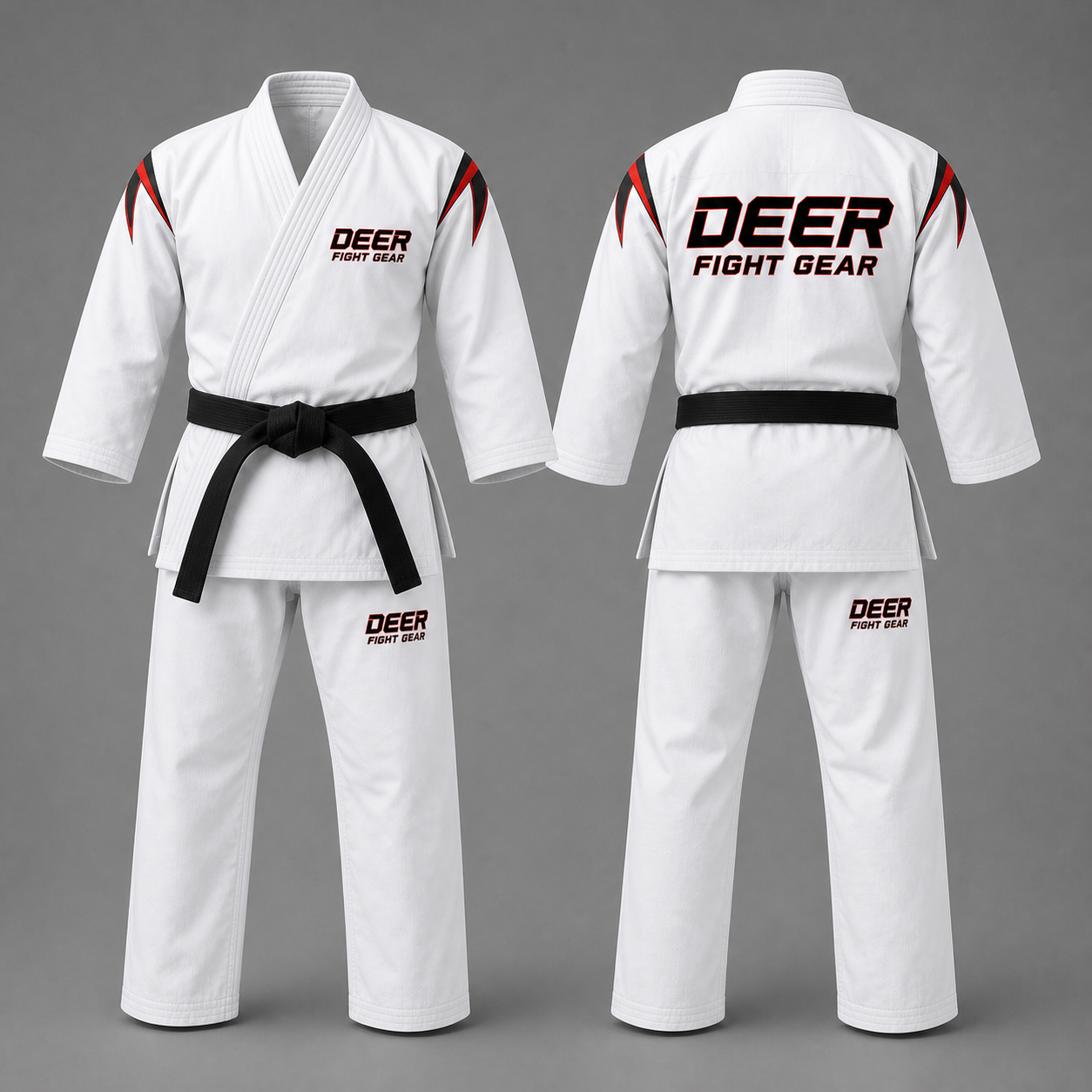
Karate Gis: Fabric, Weight, and Competition Standards
Karate uniforms, or "gis," are primarily made from cotton or cotton-polyester blend fabrics. The fabric weight — measured in ounces (oz) per square yard — is the most important specification decision:
- 6–8 oz lightweight: Ideal for children and beginners. Lightweight gis are comfortable, affordable, and easy to care for. The thinner fabric doesn't provide the dramatic "snap" effect during techniques, but at beginner levels this isn't a priority.
- 10–12 oz medium weight: The sweet spot for most adult training programs. Durable enough for daily use, heavy enough to provide satisfying technique feedback, but still comfortable in warm training environments.
- 14–16 oz heavyweight: The choice of serious competitors, particularly kata specialists who prize the dramatic visual effect of heavy fabric during performance. Double-weave fabrics in this weight range provide exceptional durability under competition conditions.
For competition-level karate gis, World Karate Federation (WKF) rules specify that gis must be white with only minor logo placement restrictions. Club badges on the chest and national federation patches are permitted, but commercial logos above specific size thresholds are prohibited in official competition. If you're supplying competition gis, verify the current WKF technical regulations and brief your factory accordingly.
Judo Suits: Weave Types and IJF Certification
Judo suits (judogi) face the most demanding construction requirements of any martial arts uniform due to the extreme forces involved in throwing and grip-fighting. The International Judo Federation (IJF) maintains strict specifications for competition judogi, including collar thickness, sleeve dimensions, jacket length, and material strength requirements.
There are three primary weave types for judo jackets:
- Single weave: Lightweight and affordable, suitable for beginners and recreational practitioners. The lighter construction breathes better but is not suitable for serious competition or advanced training where the uniform faces heavy grip stress.
- Double weave: The standard for serious judo at intermediate and advanced levels. Double weave fabric is significantly heavier and more resistant to grip forces. It's harder to grip and pull, which is valued as a training asset by many coaches.
- Gold weave (champion weave): A hybrid construction that combines the grip resistance of double weave with better weight distribution and moisture management. Gold weave judogi are the choice of elite competitors.
For IJF-approved competition judogi, the fabric must pass specific laboratory tests for tensile strength and grip resistance. If you need IJF-certified products, alert your factory at the briefing stage — certified judogi require specific materials and construction methods that cannot be applied retroactively.
Judo suit branding must comply with IJF regulations: national federation patches are mandatory in senior international competition, and club/sponsor logos are restricted in size and placement. For club supply programs not competing at international level, you have significantly more branding freedom.
Taekwondo Doboks: Style, Electronics, and Fit
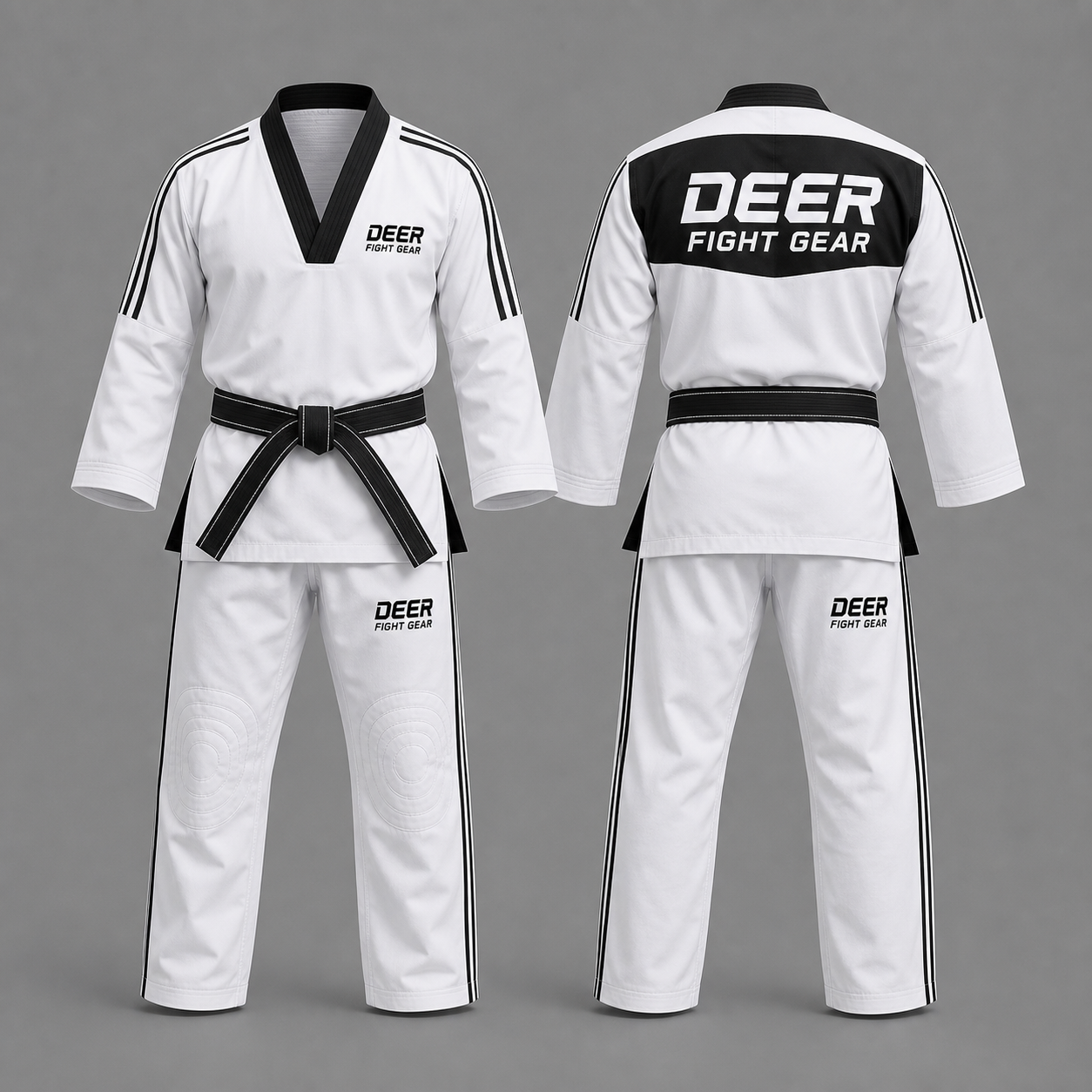
Taekwondo uniforms (doboks) have evolved significantly with the introduction of electronic scoring systems in competition. Traditional V-neck doboks remain standard for training and traditional events, but competition doboks for Olympic-style sparring now feature electronic hogu (chest protector) compatibility systems.
Key dobok specifications to discuss with your factory:
- Fabric: Modern competition doboks use lightweight polyester or polyester-spandex blends for maximum mobility. Traditional cotton doboks are still popular for poomsae (forms) competitions and traditional academies.
- Cut style: V-neck pull-over style (most common in Olympic/WT style) versus traditional cross-over front. Specify this clearly — they require completely different pattern making.
- Embroidery placement: Most doboks feature the student's name, club, or national flag on the chest or back. Confirm placement dimensions and font style in your tech pack.
- Electronic target zones: If ordering competition doboks, confirm whether they need to be compatible with specific electronic hogu systems, as this affects cut and material choices.
Club Branding: Embroidery vs Screen Print vs Woven Patch
The most common branding methods for martial arts uniforms, each with distinct trade-offs:
Embroidery is the premium standard for martial arts uniforms. It provides a professional, durable finish that withstands hundreds of wash cycles without fading or cracking. The limitation is complexity — highly detailed logos with gradients don't translate well to embroidery. Embroidery requires your artwork to be simplified to clean vector shapes with a maximum of 8–10 thread colors per design.
Screen printing allows more complex artwork and color gradients at lower cost, but durability is significantly lower on uniform fabrics that are regularly washed and dried. Screen printing is best reserved for single-event uniforms or where budget is the primary constraint.
Woven patches are a premium option for club logos and federation badges. The patch is woven on a separate loom and then sewn onto the uniform, providing excellent detail retention and a premium appearance. They're particularly popular for national team gear and high-end club programs.
Sizing and Fitting Martial Arts Uniforms for Mixed Populations
Sizing martial arts uniforms is more complex than standard apparel because the garments must accommodate both the student's frame and the loose fit required for technique execution. Standard size curves for karate, judo, and taekwondo uniforms typically run from size 000 (children) through size 7 (large adult), but different countries and manufacturers use different sizing charts.
When ordering for a mixed-age program, always request a size breakdown recommendation from your factory based on your estimated demographic. Build in 10–15% additional units in the most common sizes (typically adult medium and children's medium) to account for fitting issues. Request a pre-production size set — one unit in each size — before bulk production begins, and physically fit these on real students to validate the size chart.
At Deer Fight Gear, we manufacture custom karate gis, judo suits, and taekwondo doboks with full club branding for orders starting at 50 units per size. Our pattern makers have decades of experience with international sizing standards and can guide you through the specification process from start to finish. Contact us to request a uniform program proposal.